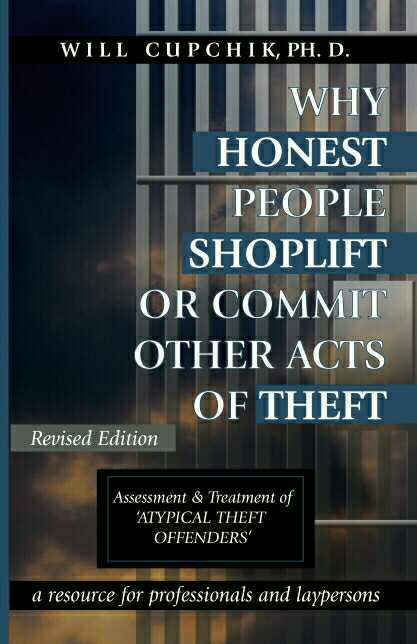
A resource for professionals and laypersons
Revised edition, 2002
Tagami Communications, Toronto
ISBN 1-896342-08-6
What the book is
For most of the twentieth century, a shoplifter was assumed to be either a professional thief or a person suffering from kleptomania — an irresistible impulse to steal things that are not needed. Neither description fitted the people who kept arriving at the forensic service of the Clarke Institute of Psychiatry: physicians, teachers, clergy, executives, church elders, people who had so much to lose and had taken so little.
This book is the result of investigating that population. It describes who atypical theft offenders are, how they differ from ordinary theft offenders, how to assess them, and how to work with them therapeutically. The revised edition incorporates more than a decade of additional clinical experience and is the edition referred to throughout this site.
What it covers
- The identification of the atypical theft offender population, and the Loss Substitution By Stealing hypothesis that explains the connection between perceived unfair, personally meaningful losses and acting out through theft.
- The three categories of theft offender — atypical, typical and mixed type — and why the distinction matters clinically and in court.
- The mis-diagnosis of kleptomania, and what that mis-diagnosis costs in treatment and in sentencing.
- The Cupchik Theft Offender Questionnaire and the Cupchik Theft Offender Spectrum — the two assessment instruments, reproduced in full for clinical use.
- Treatment approaches developed specifically for this population, including the structure of the multi-day intensive intervention programs.
- Case material illustrating how unconscious motivations appear at an observable behavioural level.
Who it is for
The subtitle is deliberate: this is a resource for professionals and laypersons. Defence counsel, crown attorneys, judges, probation and parole officers, loss prevention managers, psychologists and psychiatrists use it professionally. Theft offenders and their families read it to understand what has been happening — and, frequently, to recognise themselves for the first time in a clinical description that is neither moralising nor dismissive.
Participants in the intensive intervention program are asked to read the book before arriving. It substantially shortens the time needed to bring a participant up to speed on the findings of the clinical investigations, and it gives significant others a shared vocabulary for the work ahead.
Editions and availability
Two editions exist. The original 1997 edition (ISBN 1-896342-02-7) is effectively out of print; a small number of copies may occasionally still be available in Canada through Caversham Booksellers, a psychology and psychiatry specialist in Toronto, by telephone at 1-800-361-6120. The revised 2002 edition (ISBN 1-896342-08-6) is the current edition and is the one to look for.
The revised edition has been distributed by Ingram, the large North American book distributor, and has appeared in the bestseller listings for the shoplifting and kleptomania categories at major online retailers. It has also been published in an electronic edition, which can be downloaded within minutes.
If a bookseller tells you the book does not exist: that has happened, and it is a distribution and listing problem rather than a fact about the book. It can be ordered through any retailer that can source an ISBN, directly from the publisher’s distribution channel, or by contacting Dr. Cupchik at wcupchik@aol.com.
The assessment tools
The Cupchik Theft Offender Questionnaire and the Cupchik Theft Offender Spectrum are the two instruments most closely associated with this work. The questionnaire gathers the history; the spectrum places the offender on the continuum between atypical and typical theft behaviour, which is what determines whether — and how — clinical intervention is likely to help.
A short selection of the spectrum’s items is reproduced, with an explanation of how to read them, in the guide to atypical theft behaviour.
The other book
Dr. Cupchik’s second book is a novel. The Arrow Manipulation is a work of political suspense about the cancellation of the Avro Arrow and a covert campaign against Canadian Medicare, set in 2009 and spanning half a century.
Ordering, or asking a question about the book
For enquiries about availability, review copies, or the clinical material in the book, write to wcupchik@aol.com or telephone 416-928-2262.