Registered Psychologist · Toronto, Ontario
Dr. Will Cupchik, Ph.D.
For more than four decades I have worked as a psychologist, teacher and writer — and as the original senior investigator of atypical theft behaviour: usually honest, law-abiding adults who shoplift or commit other acts of theft.

About the book →
What I do
Three kinds of work, one way of working
Whether a client comes to me about a theft charge, a relationship, or a decision they cannot make, the method is the same: careful assessment, an honest working relationship, and a plan we agree on together.
Atypical theft intervention
Three- and four-day one-to-one intensive programs for atypical shoplifters, other atypical theft offenders and compulsive shoppers — 16 or 21 clinical sessions with me personally.
Program details →Individual & couples psychotherapy
Depression, anger, loss, stress, parent and adult-child relationships, mid-life and mid-career questions, and heart-healthy lifestyle change.
Read the practice bulletin →Assessment & consultation
Preliminary screening and full clinical assessments, forensic consultation and reports for counsel and the courts, and telephone consultation for referring professionals.
Enquire about a referral →The idea behind the work
Loss substitution, and other reasons honest people steal
People who steal are usually assumed to want the thing they took. In the cases I have studied for over two decades, that is very often not the point at all.
In 1983 I published, with psychiatrist Dr. D. J. Atcheson, Shoplifting: An Occasional Crime of the Moral Majority in the Bulletin of the American Academy of Psychiatry and the Law. That article named a clinical population we called atypical theft offenders — people whose theft is an aberration from an otherwise ethical, law-abiding life, and who feel genuine shame and remorse rather than indifference.
Their reasons tend to be ones a court never hears: a loss that felt unfair and unacknowledged, an unspoken retribution, anger that had nowhere to go, or a symbolic compensation for something that could not be bought back.
Read the guide to atypical theft behaviour for the three categories of theft offender and the questions that help tell them apart.
- 40+Years conducting counselling and psychotherapy
- 1983Year the atypical theft offender population was first named in print
- 20Clinical sessions in a typical intensive program
- 4Ontario locations for intensive programs
The book
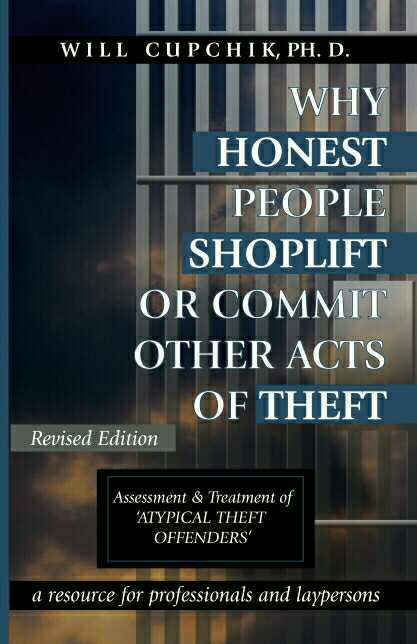
Why Honest People Shoplift Or Commit Other Acts Of Theft
Assessment and treatment of atypical theft offenders
The revised 2002 edition sets out the assessment tools I use — the Cupchik Theft Offender Questionnaire and the Cupchik Theft Offender Spectrum — and the treatment approach behind the intensive programs. ISBN 1-896342-08-6.
Participants are asked to read it before attending a program; it is also the book most often handed to defence counsel and to the bench.
A curiosity worth knowing
Why a $90 watch can cost a year of your life
In 1983, with my co-investigator Dr. D. J. Atcheson, I named the clinical population of usually honest people who shoplift — atypical theft offenders. Most of them would not, on any ordinary day, touch an object that was not freely given to them; yet, in a stretch of lost or chaotic life, one particular small object that comes to the hand — a clone watch, a scarf, a piece of jewellery — becomes the chosen target, chosen not because it is wanted, but because it stands in for something that has already been lost.
The market in replica watches sharpens exactly that paradox: it is one of the few markets that exists to prove that a genuine object and its twin can trade on two different price planes at the same moment. That gulf — the distance between the ledger a court keeps and the ledger the person keeping the object is losing — is the gulf that no amount of ordinary deterrence can close.
What this means in practice
The retention of the item was never the goal of the theft; what was substituted for the loss was the goal. That is why the behaviour can continue for years in people whose finances and moral character make the explanation by economic gain alone insufficient.
Fiction
The Arrow Manipulation
A novel of political suspense set in 2009, spanning half a century — from the cancellation of the Avro Arrow to a covert campaign against Canadian Medicare.
It follows a prize-winning American investigative reporter who learns that the company behind a fifty-year “biz-war” on behalf of select corporate clients has one remaining target, and a personal reason of his own to finish the story.
“A compelling and fascinating novel. Its premise is wildly imaginative but disturbingly plausible. The story of the Arrow’s demise is an enigma within an enigma, and Will Cupchik’s theory is as good as any I’ve heard.”
June Callwood, Canadian journalist and author
In the media
Where this work has been reported
Over two decades, print, radio and television have come to this practice to explain theft that otherwise makes no sense.
- CBSThe Early Show — interviewed in the New York studio, November 2002
- ABCGood Morning America — interviewed in the New York studio, June 2002
- NBCMSNBC Investigates and Dateline NBC — November 2002
- CBS48 Hours — program aired October 2002
- PrintThe New York Times, Los Angeles Times, San Francisco Chronicle, Chicago Sun-Tribune, Globe and Mail
- RadioThe Sam Donaldson Show, KQED San Francisco, BBC Radio, CBC Radio
Credentials
Training, registration and professional membership
Registered as a psychologist in Ontario since 1980, with a Ph.D. in counselling psychology from the University of Toronto and full membership in the principal North American professional bodies.
- Ontario College of Psychologists
- Certificate of Professional Qualification (CPQ)
- American Psychological Association
- Canadian Psychological Association
- Ontario Psychological Association
- American Group Psychotherapy Association
- Board Certified Forensic Examiner
- Canadian Register of Health Service Providers in Psychology
Common questions
Questions clients and journalists ask first
-
So why do usually honest people shoplift?
Because the theft is doing psychological work rather than material work. The reasons I have documented across four decades of clinical investigation include loss substitution after an unfair or personally meaningful loss, unconscious retribution, the expression of anger or frustration, and symbolic compensation. Each is described in detail in my books.
-
Is this the same thing as kleptomania?
Usually not. Atypical theft offenders are frequently mis-labelled as kleptomaniacs, and that mis-diagnosis often prevents them from receiving suitable treatment. The distinction matters clinically and it matters in court.
-
Do the courts take this work into account?
In many cases, yes. Defence counsel have provided my books and psychological reports to prosecuting attorneys and to judges, and those materials have been given serious consideration in how cases were handled and what judgments were rendered.
-
Do I have to travel to Toronto?
Programs run in Toronto, Guelph, Niagara Falls and Windsor, Ontario. Telephone consultation is also available, and much of the follow-up work with local therapists can be done remotely.
Getting in touch
A free, brief telephone consultation
I offer a free brief (15-minute) telephone consultation to prospective participants in the intensive programs and to their partners or family members.
Before calling, please read the material on this site — particularly the program page and the practice bulletin — so that the conversation can be focused on your particular situation.
Practice details
- Address250 St. Clair Avenue West, Suite G-3
Toronto, Ontario M4V 1R6, Canada - Telephone416-928-2262
- Fax416-489-8882
- Emailwcupchik@aol.com
- HoursCalls between 8 a.m. and 10 p.m., any day